What is sexual safety?
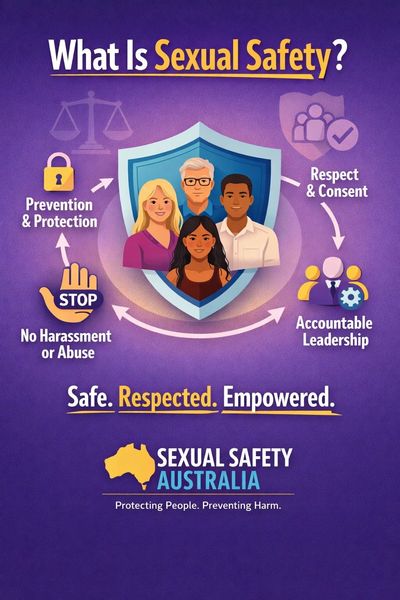
Sexual safety is the right of every person to live, work, learn and participate in society free from sexual harassment, sexual abuse, sexual violence, sexual intimidation, and sexually harmful behaviour.
Sexual Safety Australia defines sexual safety as a preventative, whole-of-system approach that protects people through culture, accountability, and informed leadership — not just policies or compliance.
It is not just the absence of harm. Sexual safety exists when people feel respected, believed, protected, and supported — and when systems, cultures, and leaders actively prevent harm before it occurs.
Sexual safety is a human right, a work health and safety obligation, and a shared societal responsibility.
Sexual Safety Is More Than Sexual Harassment Training
For many years, sexual safety has been narrowly framed as sexual harassment training — often limited to policies, annual online compliance modules, or an issue addressed only after a complaint is made.
This reactive, compliance-only approach is no longer sufficient — and evidence clearly shows it has not prevented sexual harm.
At Sexual Safety Australia, sexual safety is understood as broader, deeper, and fundamentally preventative.
What Sexual Safety Really Means
Sexual safety extends far beyond policies or training checklists. It includes:
- Respectful, inclusive workplace culture
- Clear boundaries and informed consent
- Understanding power, gender, hierarchy, and vulnerability
- Psychological safety
- Trauma-informed responses
- Responding to domestic violence disclosures and Domestic Violence awareness
- Accountability at leadership and organisational levels
- Early identification of red flags and risk behaviours
- Systems that protect people — not reputations
Sexual safety is not achieved by documentation alone.
It is embedded through culture, leadership, and action.
What Sexual Safety Actually Encompasses
Sexual safety includes protection from:
- Sexual harassment
- Sexual assault and sexual abuse
- Sexually explicit jokes, comments, and imagery
- Workplace pornography and sexualised content
- Sexualised bullying or coercion
- Sex-based harassment
- Online and digital sexual misconduct
- Technology-facilitated abuse
- Retaliation for reporting concerns
- Misuse of power, authority, or trust
- Grooming behaviours
- The normalisation of harmful sexual behaviour
- Domestic violence workplace safety planning
- Domestic violence referral pathways for victims and perpetrators
Importantly, sexual safety also includes how organisations respond when concerns are raised — not just what is written in policies.
Why Sexual Safety Matters: The Evidence
Despite decades of policies and training requirements, sexual harm remains widespread.
Research consistently shows:
- 1 in 3 women experience sexual harassment at work
- 1 in 2 people experience sexual harassment at some point in their working life
- Most incidents are never formally reported
- Fear of retaliation, disbelief, career damage, or being labelled “difficult” are major barriers to reporting
- When complaints are made, many workers report that the organisational response caused additional harm, including stress, anxiety, isolation, and job loss
Sexual harm also disproportionately affects:
- Men and boys
- LGBTQIA+ people
- People with disability
- Migrant workers
- Young workers
- Casual and insecure workers
- People in male-dominated or high-risk industries
Sexual harm is not rare or isolated.
It is a predictable outcome of unsafe systems and workplace cultures.
Sexual Safety Is a Work Health and Safety Issue
Sexual harassment and sexual harm are recognised as psychosocial hazards under work health and safety frameworks.
This means organisations have a positive duty to:
- Identify sexual safety risks
- Prevent harm before it occurs
- Address unsafe workplace cultures
- Respond appropriately when issues arise
- Protect workers from retaliation
- Provide safe and trusted reporting pathways
- Act on early warning signs and risk indicators
Waiting until someone is harmed — or until a formal complaint is lodged — is no longer acceptable.
Trauma-Informed Sexual Safety
A trauma-informed approach recognises that:
- Sexual harm affects the nervous system and mental health
- People may not report immediately — or at all
- Memory, behaviour, and communication may change after trauma
- Repeatedly retelling experiences can be re-traumatising
- Disbelief or minimisation causes further harm
Sexual safety requires responses that are:
- Calm
- Respectful
- Believing
- Confidential
- Non-punitive
- Survivor-centred
- Focused on safety, not blame
Sexual Safety Is Everyone’s Responsibility
Sexual safety is not just:
- A women’s issue
- A HR issue
- A legal issue
It is a leadership issue, a culture issue, and a community responsibility.
Sexual safety improves:
- Employee wellbeing
- Retention and performance
- Trust and morale
- Reputation and brand integrity
- Legal and regulatory compliance
- Organisational resilience
Most importantly, it protects people.
What a Sexually Safe Organisation Looks Like
What a Sexually Safe Organisation Looks Like
A sexually safe organisation:
- Takes concerns seriously — early
- Acts before harm escalates
- Trains everyone, not just managers
- Holds leaders accountable
- Protects whistleblowers and reporters
- Does not retaliate
- Understands high-risk roles and environments
- Reviews systems, not just individuals
- Commits to continuous improvement
Sexual Safety Is About Dignity
At its core, sexual safety is about human dignity.
Everyone deserves:
- To feel safe at work
- To be respected
- To be believed
- To be protected
- To go home without fear
Sexual safety is not radical. It is not political.
It is fundamental.
FAQ
Have questions about our services? Check out our FAQ section for answers to some of the most commonly asked questions. If you don't find what you're looking for, feel free to contact us directly.